
China has been taking "incremental and tactical actions" to press its claims at the Line of Actual Control (LAC) with India and has unsuccessfully sought to prevent New Delhi from deepening its relationship with the US during and subsequent to the standoff, the Pentagon has said in a major report on China's military modernisation.

The Tibetan nation still lives under the yoke of the Chinese Communist Party, and Beijing today has a guilty conscience; this creates a great uneasiness for Xi Jinping and his colleagues observes Claude Arpi.

China has chosen to keep New Delhi guessing, while retaining for itself the option of constantly changing facts on the ground and shifting the LAC westwards -- the strategy called 'salami slicing', notes Ajai Shukla.
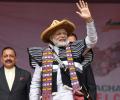
New Delhi's reaction came in response to Beijing announcing Chinese names for 11 more places in Arunachal Pradesh which the neighbouring country claims as southern part Tibet.
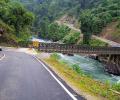
The United States has recognised that territory (Arunachal Pradesh) for a long time (as an integral part of India), White House Press Secretary Karine Jean-Pierre said.

A powerful senatorial committee on Wednesday is set to consider a bipartisan resolution to recognise Arunachal Pradesh as an integral part of India, pushing back against China's military aggression to change the status quo along the Line of Actual Control.

'Unless India ups the ante, Beijing will continue to believe its transgressions are cost free and will feel encouraged to do more of the same.'
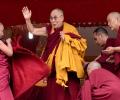
Reports from Tokyo said the Dalai Lama while speaking at an online press conference hosted by the Tokyo Foreign Correspondents Club on Wednesday said, 'I prefer to remain here in India, peacefully', praising the country as a centre of religious harmony.
The Sichuan-Tibet Railway will be the second railway line into Tibet after the Qinghai-Tibet Railway project. It will go through the southeast of the Qinghai-Tibet Plateau, one of the world's most geologically active areas, according to the Chinese official media.

'The choice of Dhoka La for the intrusion by Chinese troops is significant and suggests a twin objective of pressuring Thimpu to allow Beijing to establish an embassy there and reinforcing Chinese claims on Arunachal Pradesh,' warns former RA&W officer Jayadev Ranade.

He said China's "growing imprint" will surely increase contestation and competition in the economic domain and it will attempt to keep India engaged on issues relating to the unsettled borders.

The Chinese inference is that if the Chinese visa is embossed on an Indian passport, held by Indian citizens from Arunachal Pradesh, it may be tantamount to recognising Indian sovereignty over Arunachal Pradesh, states Rup Narayan Das.

The Blinken visit indicated that the Biden administration is still somewhat tentative about the specifics of its relations with India, observes Ambassador T P Sreenivasan, who has served multiple stints at India's embassy in Washington, DC.

He also said 'Akhand Bharat' was true but divided Bharat was a "nightmare".


The exercise was aimed at validating joint plans for strategic airlift of specialised forces employing IAF's fixed and rotary wing platforms by landing and dropping in designated areas for undertaking kinetic actions, they said.

'The numbers of troops on both sides are enormous.' 'They are about 50,000-60,000 soldiers facing each other in that sector -- that's about the total number of troops that both sides had in the 1962 War in all sectors.'
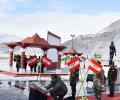
The Chinese authorities have been rapidly building defence infrastructure along the Line of Actual Control, indicating that they are preparing for a long period of tension with India, points out Jayadeva Ranade, the former senior RA&W officer and China expert.

Asked about the reports of the troops on both sides disengaging and moving back to their previous positions, Chinese foreign ministry spokesperson Hua Chunying told a media briefing in Beijing that both sides are taking steps to ease the situation along the borders.

'While wishing the Tibetan leader a long and healthy life, one can hope for a 'selection' of the Tibetan leader in the Indian Himalayas.' 'It is vital for Tibetan Buddhism, but it is also in India's political interests,' says Claude Arpi.
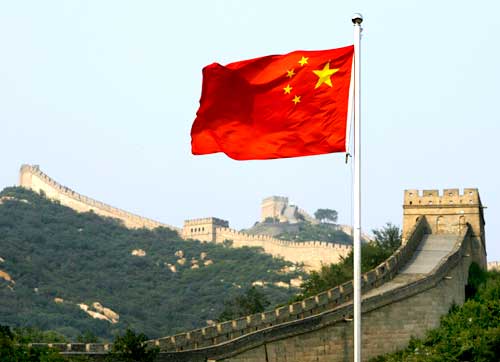
Bhutan firmly abides by the one-China principle meaning Taiwan and Tibet are part of China and stands ready to work with China for an early settlement of the boundary issue and advance the political process of establishing diplomatic relations, it said.

China firmly opposes all forms of contacts between foreign officials and the Dalai Lama, he said.
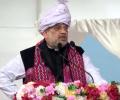
China on Monday criticised Home Minister Amit Shah's visit to Arunachal Pradesh, stating that it violated Chinese sovereignty over the area, a claim outrightly dismissed by India.
China routinely objects to Indian leaders' visits to Arunachal Pradesh to buttress its stand.

It took India and the Indian Army to show to the world that enough is enough and to challenge the neighbourhood bully, he said.

Penpa Tsering was on Thursday sworn-in as president of the Central Tibetan Administration, the Dharamshala-based Tibetan government-in-exile, and said he will reach out to the Chinese government to find a "mutually beneficial" and non-violent solution to the Sino-Tibet conflict.

Nearly two decades ago, then defence minister George Fernandes said: 'China has built roads up to the border, while there has been negligence on India's part.' Since Fernandes uttered these brave words, what has been done on the Indian side? The Modi Sarkar is apparently trying, but little has been achieved so far, says Claude Arpi.

'The PLA has continued to do exercises and drills and recently carried out air exercises with fighter jets.'

'It is not a matter of fixing the military problem up there in the Himalayas and the retreat of the two militaries.' 'India has to find a way to correct the racist and very patronising views of India in the Chinese mind.'

All that India must aim for is to match China's military prowess adjusted to equal Beijing's India-specific military capability, argues Vivek Gumaste.

'The deepening of China-Nepal relations need not cause heartburn in India,' says Ambassador M K Bhadrakumar.

'It is certainly time for New Delhi to open up. Not only should it go ahead at full steam with the roads to the LAC, but the government must also allow tourists to visit these stunningly beautiful areas of Indian territory.'

'We must understand that the LAC is a political issue for China, so any action on the LAC will keep India focussed on the LAC which gives China the opportunity for any adventurism in the Indian Ocean.'

Tsering described the gesture as an "innocent grandfatherly affectionate demeanour" that was followed by his "jovial prank" with a tongue.

'It is a pattern of behaviour of the Chinese that whenever a Chinese leader visits India or an Indian leader visits China, some incidents take place.' 'When Modi visits China, we should look out for some similar demonstration by the Chinese.'

The onus today is on China, but it also requires a little diplomatic finesse from India, backed by a modernised armed force, argues BJP MP Subramanian Swamy in this excerpt from his new book, Himalayan Challenge: India, China And The Quest For Peace.

'Modi warned China, therefore they have come to the talks.' 'Nothing will come out of these talks.'
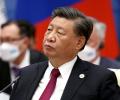
Xi Jinping's recent actions in South Asia have amply demonstrated the disastrous impact of China's embrace, observes Jayadeva Ranade, the retired senior RA&W officer and China expert.
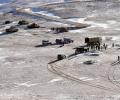
Both countries have reached a mutual agreement for disengagement of troops from the most contentious area of North and South Pangong Lake.

Russia has already begun delivery of the first S-400 systems, and the question of sanctions, or of a waiver to sanctions, preoccupies New Delhi.
